Friday, May 1, 2015

No Animals Were Harmed in the Making of this Exhibit

Our mountain lion: Queen of all she surveys


Camouflage- helping desert animals survive, even in museums

 One of the things people love in museum exhibits are animals- and in a museum that focuses on celebrating the desert and local Native American voices, animals are especially important.   There are currently two animal statues in our exhibit, both so lifelike that they might be mistaken for real animals.   Early in design process, we determined that all representation of animals in the exhibit would be sculptural. In many respects, this follows the current trends in the museum field; it also played into the strengths of our design team.


  Bridget Keimel is a Senior Modelmaker at Weldon Exhibits. When making statues she starts with lots of reference photographs for the animal she will be creating. What does it look like? How do muscles bunch, tails drape, and eyes shine? 
            For the case of both our desert animals, she began with the same premade foam base sculpted bodies that taxidermists use when mounting animals. The foam manikins can be altered to fit a desired pose.           
         
Fishing line for whiskers- art from the unusual?

   Our animals were made in Weldon Exhibits’ workshop in conjunction with the rocks that would be their domain. An animal that will stand where it can be touched, like our Borrego, has rods in its feet anchoring it to the rock base. The mountain lion, on the other hand, was built separately to fit a rocky perch that was designed in the workshop. The lion was put into place when she reached the museum.  The lion’s tail was a separate piece attached later, allowing for last minute adjustments to the rocks as well as the tail for the maximum realistic effect.


Some assembly required
            Some parts of our animals are made with common materials. Glass eyes give the Borrego his soulful gaze, and the mountain lion’s whiskers are made from fishing line.  Cement, epoxy putty, and stucco are used to make layers of muscle and fur, with stronger materials used if the animal will be touched frequently.  


Photo op! Only time you'll get a Borrego to pose with you


Our Borrego was designed with the idea that he would probably be touched a lot; he will endure a lot of wear and tear. 

In fact, he has become the center of a new social media campaign- Sheep Selfies (#shelfie).  Designed as a photo opportunity, we invite people to send us their photographs of themselves and their families with the sheep for us to post on Facebook and Twitter. Who knows- can his own Twitter account be far behind?
What's it called when a sheep takes a selfie? A #shelfie of course!


Tuesday, April 14, 2015

Rocking a Museum

Rocks coming to the Museum

This Sunday we had our first group of visitors to see the "behind-the scenes" construction zone that is currently the museum.  While I know it's more traditional to not show people a new exhibit, especially something as major as we're building, before it is complete, I think it is important for the community to be a part of the entire process.  Here in the Imperial Valley people have been waiting and supporting this museum for years and are excited that we are finally graduating to a permanent exhibit.  "Becoming a real museum" as so many visitors call it.  My philosophy on what a "real museum" is can wait for another blog though.  Today is about what goes on behind-the-scenes of rocking an exhibit.

Travertine Point's waterline, in progress


One of the features of our new museum that everyone was blown away by were the large rocks we have throughout the building.  Built into each section of the museum you now find giant fake rocks that look exactly like rocks you would find hiking in the Valley.  When the installation is finished there will be pull-out panels describing a hike in the area where you would see these rocks "in the wild" as well as explanations for different features, like Travertine Point's water line.


How are these rocks designed and built so that you can't tell a real rock from a fake? According to the designers at Weldon Exhibits it all starts with photographs and rock samples.  A scale model is built in the workshop in order to work out design issues, location issues, etc.  A full sized model is built next onto mocked up walls simulating their final location. The foam models are then carved and shaped with hot wires, saws and knives until the features are perfect.  Layers of plaster coat the model, soaking into the foam and creating a shell that will keep the rocks from being damaged.  Different coats create a rocky texture and seal the structure.  Everything is then dismantled, boxed, shipped, and reassembled in its new home.  Layers of paint are applied referencing more photographs to endure that the end result looks like the original.  For most of the rocks here that means layers of weathering, orange desert varnish and patina, quartz veins, and different textures for granite, basalt, tufa, etc.  One large rock piece can weigh several hundred pounds, take a week to build in the workshop, then up to two days of a team painting them during installation before they are declared ready to go.

Rocks foamed and ready for paint

Layers of paint and days of work go into the details of rock painting

While on site some changes may be made. They installation team was inspired to add a few real rocks to one section of the design, although it will take a close examination for anyone to pick out the real rocks from the manmade ones.  The end result is something durable enough to handle hordes of field trips, but realistic enough to be instantly recognizable as certain areas to hikers.  While many visitors may see these as merely frames to the exhibit, others will see them as a seamlessly integrated aspect of the exhibit- another way of reminding us all that the desert and the people who live here are deeply entwined. And perhaps that science, history, and art are just as connected.


In progress veined rock, and rocks with 'patina' applied

Friday, April 3, 2015

Installing a New Exhibit Begins

Looking good, even in protective wrap!
Monday, March 30 and Tuesday, March 31 trucks arrived and members of the Weldon Exhibitsteam spent an intense two days unloading exhibit components.  Wednesday began installation and even at the start of Day 3 you can already see the exhibits starting to take shape. 

Unloading components
Before installation
  
It's thrilling to see what we've only imagined through design drawings starting to take shape in our museum- we hope you're getting as excited as we are!
WE staff applying photographic mural

Our sheep will supervise the rest of installation 


Sunday, November 9, 2014

Written in the Land: the Mystery of Geoglyphs

One of the major projects I have been working on lately involves geoglyphs.  These earthen art designs are found in large amounts in places like Peru (the famous Nazca lines are geoglyphs), Chile, Australia, and the extreme southwestern United States- in other words: where I live. At the museum I am taking in a large collection of aerial photographs by local photographer and pilot Harry Casey, who has been flying over the geoglyphs for over 30 years, photographing changes to the land and the geoglyphs.  As of now the collection includes over 5,000 print and 500 slide photographs, with more yet to be accessioned.  I'm working closely with Harry and his wife Peg, going over images with them, listening to the stories behind the photos and the people who recorded them as well as the theories of the images themselves.  Three oversized images were included in our recent Seaweed, Salmon, and Manzanita Cider: A California Indian Feast exhibit and visitors were amazed- both by the beauty of the images and the fact that most of them had never heard of the geoglyphs. A recent article in our bi-weekly Land of Extremes newspaper series introduced local geoglyphs to a wider audience.


Photographing geoglyphs from above shows the images as they cannot be seen from the ground


This Saturday my co-worker and I accompanied Harry and Peg on the next step in our geoglyph education.  We drove to Pilot Knob, Arizona to record latitude and longitude for the geoglyphs found there.  The most famous, and easiest to see, is the Horse.  While some of our geoglyphs have been dated several thousand years old, the horse is obviously a much more recent work, based on its content. Horses have been extinct in the Americas for thousands of years, returning with the Spanish in the 1500s.

Desert pavement
The area around Pilot Knob has desert pavement perfect for geoglyphs, better than the pavement found in my area of the Yuha.  Looking over the rocks on the plateaus by the images we were able to see extensive desert varnish, the orange-red color found on the bottom of rocks that have remained undisturbed for thousands of years.  We were able to see tools scattered across the area: scrapers and choppers as beautiful or more than any in our collection.  Jessica even found some small fossils from when the area was under the ocean millions of years ago.


As tempting as it may be to remove these artifacts, thinking you are protecting them from the elements or other people, it is important to resist the temptation.  Artifacts randomly removed from an archaeological site are removed from their context, removing the story of the area as well as the artifacts themselves.  Take photos or drawings, not rocks.  

Thursday, November 6, 2014

So long and thanks for all the fish!


(My apologies to Douglas Adams, but how often does a museum get to use a play on words like that?)

Staff member Jessica Brody says goodbye to the Salmon


With this weekend's Shawii Day we said goodbye to our latest traveling exhibit: Exhibit Envoy's Seaweed, Salmon, and Manzanita Cider: A California Indian Feast. This eight week exhibit explored foods native to California and how they were traditionally prepared by Native Californians.  Using artifacts from our collections that related to food and hunting we were able to supplement the statewide exhibit with information specific to the Kumeyaay Nation.

Young visitors enjoy baskets on loan from Manzanita
Between August 16 and October 12, 562 visitors came through the museum for the exhibit.  That's about 14 people each day we were open for eight weeks!  Visitors came from El Centro, Brawley, and San Diego; Freedom Academycame out from Holtville for a field trip;  and the San Diego Association of Geologists hiked out for their annual field trip.

A young expert teaches our Jessica Brody to crack acorns

We were thrilled by the positive response everyone had to this exhibit.  People loved learning new things about foods they thought they knew, and how complicated it was to prepare foods when today we have a microwave handy!

Staff member Albert Lutz takes down the exhibit


We have now begun the process of not only taking down Salmon to go onto its next home, but everything else in the museum's public area.  As you know, we will be closed for a few months of construction and when we open back up in the Spring we will have an exciting new permanent exhibit! You've supported us through the long beginning- now prepare to be amazed!

Don't worry- we'll be keeping everyone up to date on construction through the blog and Facebook- follow along in this stage of our adventure!
Up next: Mocking up our new visible storage exhibit!

Monday, September 29, 2014

Tool Class with Stan- or Remembering the Hands-on Approach


making arrows with Stan Rodriguez

I've been so busy with work these last few months that I have let a lot of things slide.  This blog, even though I have plenty to write about that is archives and museum related, keeping in touch with friends and family, and pretty much anything not directly related to the work of building a new exhibit.  Plus the other 30 or so jobs I do every day to try and keep the museum treading water.  I'm not complaining- more like apologizing to readers (and friends and family) and trying to set up an explanation for this post.

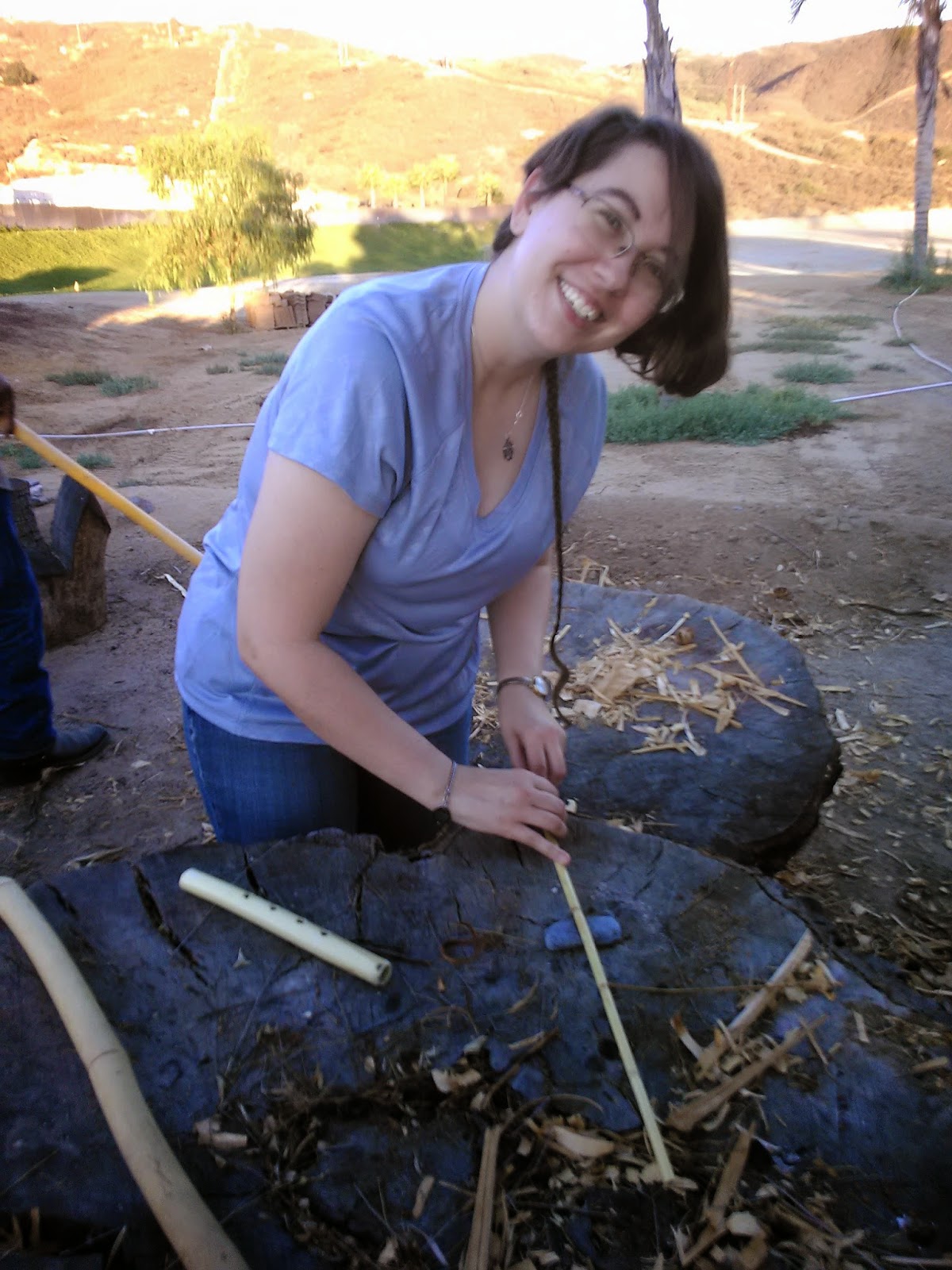
On Wednesday, my co-worker Jessica and I drove up to Kumeyaay Community College on the Sycuan reservation to meet with Jess's friend Stan Rodriguez.  Stan is very active in tribal education and communication and has agreed to help us with a few aspects of the exhibit the museum is building.  Specifically, we needed an arrow and a pair of sandals for the exhibit and he agreed to help.  We went up and had a fantastic few hours with Stan- he taught us how to make arrows, how to weave agave fiber, and didn't laugh at us when it was pretty clear we had no idea what we were doing, but just encouraged us to relax and try again.

One of the things I was most excited about was getting to actually use an arrow shaft straightener.  We have a large collection of straighteners in the museum and I had done a lot of research on them for a newspaper article and to help me revise exhibit text.  But until this week it had all been theoretical knowledge.  Now I've actually used a heated straightener, heard it hiss as I straighten a carrizo reed on it, and learned the best ways to ensure that the reed ends up straight.

Using an arrow shaft straightener
I've not only handled the fiber of an agave plant, I've helped make the sandals that will go into our exhibit. Granted, Stan did most of it since the idea is that they actually look like sandals, but I worked on them too.  The night was a great reminder that hands-on learning is both fun and essential to museum staff, and archives staff as well.  You are not just preserving artifacts, photographs, or papers- you are helping to tell stories of people and how they live.  You are entering the lives and cultures of other people and hopefully coming away with not only a better understanding of those lives but also more respect.  As one visitor said after seeing our exhibit- "Now when I go out into the desert I think I will have more understanding of how people lived here. It is amazing to realize how it was done and that today most of us couldn't manage it."

The desert has stories to tell, and we can only begin to understand and appreciate those stories when we immerse ourselves in the environment.    Whether that is hiking in the desert, learning to make sandals from an agave plant, or turning book knowledge into reality, these are all important ways to relate to our work and see things in different ways.  Plus, it's important to remember to get out and interact with people and have fun sometimes- even if you can only schedule it in by telling yourself you're working.


Hand made agave fiber sandals

Wednesday, August 27, 2014

New exhibit at the museum


This weekend marked the opening of our new traveling exhibit Seaweed, Salmon, and Manzanita Cider: A California Indian Feast.  Opening weekend was sponsored by Imperial Valley Aggregates and Gibson & Schaeffer Inc. - and therefore free to the public. We were thrilled that over 100 people joined us over the three day festivities to celebrate our    
largest traveling exhibit yet.


Family sees what could be found in Lake Cahuilla
Friends, family, Museum members, and first time visitors all came out to experience this new exhibit.  They enjoyed two different videos running in different locations- one that came with the exhibit on making acorn bread and the award winning First People Kumeyaay. They learned new and exciting things about grinding the all important acorn for food and roasting agave in pits.  And everyone loved the take away recipes!  Hopefully we'll hear back from people after they've made the meals to tell us how they liked it!


Kids enjoyed a new twist on our signature coiled clay program by also learning a bit about finding clay in its natural state and how the Kumeyaay ground it to create the pliable clay needed for ceramics.  There are also grinding stones in the exhibit from our education collection that can be touched and a game where kids try to think of everything they would need to make their own dinner.
Learning to grind clay


What are YOU making for dinner?


Tools for hunting on view
 With the exception of historical photographs of food preparation and hunting, jars of food provided by Exhibit Envoy, and a basket collection on loan to the museum from Johnny Eagle Spirit Elliot of Manzanita Band of the Kumeyaay Nation, all artifacts on display came from the museum's collections- many never before on view to the public.  All the artifacts relate to food: hunting it, cooking it, eating it.  While learning about the importance of fishing for food our visitors can also see a map of Lake Cahuilla and learn a little more about that fascinating part of our desert landscape.  Shells from both the ocean and Lake Cahuilla are on display, as are a collection of projectile points found along the lake's shorelines.  In an area on hunting visitors can not only see knives, arrows shaft straighteners, and throwing sticks- they can also see a preview of the upcoming permanent exhibit.  A collection of projectile points takes the visitor through a journey of changing technology, changing climate, and changing game.  From mammoths to rabbits, we have taken lot of visitor feedback into consideration when designing this case.

Baskets on loan for this exhibit only


Seaweed, Salmon, and Manzanita Cider: A California Indian Feast will be at the Imperial Valley Desert Museum until Saturday, October 11.  If you and your family weren't able to come for the opening weekend fun, we hope you have the chance to stop by and see this once in a lifetime exhibit before it leaves the valley!