Showing posts with label museums. Show all posts

Wednesday, February 12, 2020

Ancient Adventures in London


"The Shield of Achilles" 1822. Rundell, Bridge & Rundell, from a design by John Flaxman

Last week I did something that- for me- is a bit crazy: I went on vacation.  A trip to London and Bath, a chance to visit with my good friend Kristin from Simmons College, and to explore some amazing new places- why not?

"Helen of Troy" ~1812. Antonio Canova

The adventure came about when I heard the British Museum was holding a temporary exhibit on Troy: myth and reality.  It started with "I wish I could see that" and eventually turned into "why not?".  Kristin was more than willing to go with me and we spent a day exploring the exhibit, as well as some of the Greek and Assyrian permanent exhibits the Museum displays.   Troy was a good exhibit, with pottery, statues, and paintings of different stories and interpretations of Homer's Iliad and Odyssey.  The exhibit design kept things simple: interpretations were basic ones stating the myth being depicted.  What emphasis and interpretation the viewer wanted out of the experience was up to them.  Was this an art exhibit featuring fantastic statues and pottery?  Were we meant to think of the incredible impact these epic poems have had across the Western world's culture? Debate war and culture, genocide and regrowth (the exhibit did remind us that Aeneas left fallen Troy and went on to found Rome). A brief section at the end (Kristin overheard one visitor remark: "Women at the end. Nothing's changed") brought up the idea of women in the story, while rather neutrally leaving us to debate feminism and female influence in a patriarchal world over lunch in the museum's cafe.


Mithraeum inner temple
The next day continued our Roman Holiday with a trip to the London Mithraeum- a place I accidentally heard about online before my trip and was thrilled that Kristin was also up for seeing.  A reconstructed Roman temple to Mithras, a "faithful recreation of the ruin that was discovered in 1952-54" on a bomb site according to their publications, the Mithraeum highlights a selection of 600 extremely well preserved artifacts from the time period.  They used technology to cleverly help visitors engage with the wall of artifacts: visitors could pick up a tablet and find any artifact on the wall mirrored on the tablet's main page.  Tapping the image gave visitors more detailed explanations of what they were looking at, and meant that people could move around and see things without slowing going from one artifact label to another.  It also clearly engaged children who might otherwise not have been interested.  When ready you descend into a chamber where you can sit and listen to archaeologists giving recorded talks or you could explore the interactive displays that explained Mithras, what was known about the temple and the ceremonies, and pointed out specific designs carved into the stone that would have been part of the alter.  Going into the recreated temple itself you experienced a well done, brief interactive: visitors stand along the sides and watch as the changing lights create the effect of seeing columns, hearing people chanting and moving about, etc.


Centerpiece design of Mithraeum. Museum of London
While reading about the temple we noticed that the statues themselves were on display at the Museum of London. We were interested and walked over the find them.  The Roman exhibits have clearly not been updated in awhile, but overall stood the test of time.  Plenty of families were exploring the exhibits when we were there, although we found the area for Mithras pretty quiet.  Having gone from the Mithraeum itself to this exhibit was fascinating, and really let us get the entire feeling of the site and the life worshipers might have been living.


Note: This blog post is not attempting to analyze the exhibits, or museums, in professional terms- although I may come back and do that in another post. The Mithraeum in particular left me highly impressed in terms of professional exhibits.  This is simply a general post to let friends and family know what I've been up to, and maybe encourage others to explore these museums.

Monday, September 18, 2017

Project Completed! For now

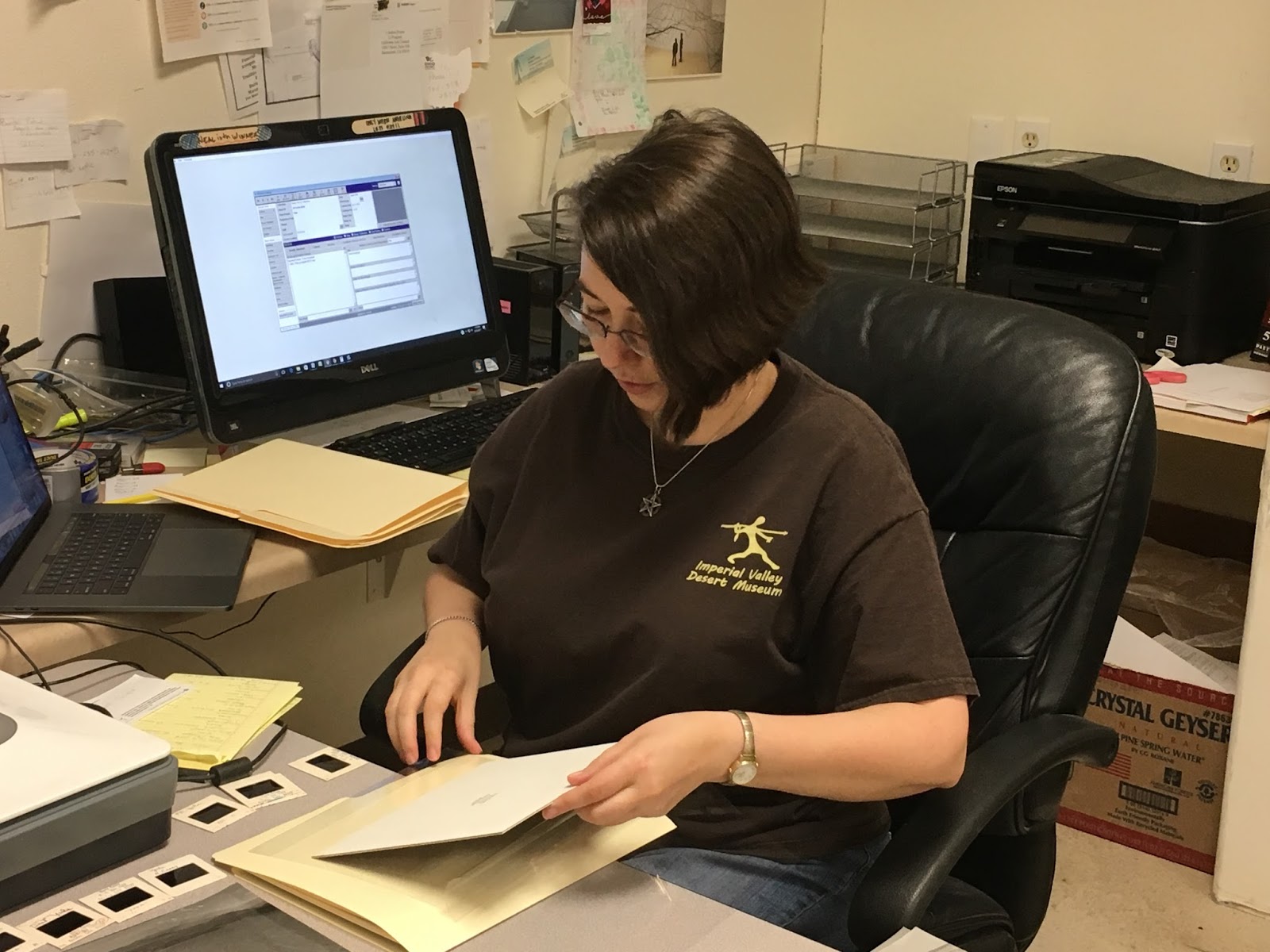
Archiving, accessioning to PastPerfect, digitizing, & encapsulating photos and slides

It's hard to believe it's nearly the end of September already.  A month ago I began an intense digitization project at the Imperial Valley Desert Museum with the goal of scanning all photographs in the Harry Casey Collection that connected to geoglyphs.  In a collection of more than 8,000 individual images, I knew the bulk of them pertained to geoglyphs, but what did that mean? All 8,000? 7,000?


30 days, 230.5 hours, and 2 scanners later, the answer is 4,462.  That's the number of photographs scanned, although there were over 1,000 duplicate copies of individual images.


2 scanners worked hard on this project!
What's next? What was the point of becoming the Mad Scanner? I'll be working with photographer Harry Casey and Sunbelt Publications to put together Harry's manuscript with accompanying images for publication.  The museum will apply for grants to create an interactive digital exhibit based on the work.  After that? There are plenty more ideas waiting to be implemented- not to mention almost another 4,000 photographs of rock art, Nazca Lines, and desert plants waiting to be scanned and create exciting, interesting, and beautiful exhibits!


A special thanks to Dr. David Breeckner, Angelina Coble, and Marcie Rodriguez for all their help with this project!


Marcie examines a slide

Tuesday, September 27, 2016

Iteration, Iteration

Angelina Coble with new desert tortoise test panels
If there is one thing I've learned working with Neal Hitch these past few years it is "iteration, iteration, iteration".  Did something work? How can it work better?  What can you tweak to get more interaction?  Did something not work? Why not? What can you change?


This week I designed the second generation of our test sign panels to see what people wanted in outdoor signage. I took all of the comments and feedback we received from visitors on the original roadrunner panels and made a set of panels that took these comments into account, while still asking visitors to think of what it was they liked in different signs.  
Some comments were the same across the test signs: everyone liked the habitat range maps, the footprint examples (despite my bad artist's rendition!), and some of the fun facts.  While most people were leaning towards the flip signs by the end of the first test, it was still mixed enough that I decided to test both single panel and flip signs again to get a larger audience feedback.  


Angelina Coble writing sign prompt
The biggest thing that I changed was to include audience prompts.  Apparently it wasn't obvious enough in the first round of test panels that we wanted visitors to give their opinions of the signs, or certain features they liked best about the different signs, even though we seeded comments on each of the boards to act as prompts.  So, this time I wrote out specific questions on the top of each sheet.  The hope is that this will further prompt visitors to give the opinions I'm interested in, that will play into future sign design.  Hopefully it will also help people to understand that they are being given options to choose which they like best, something that seems to not have always been clear in the first round.  Even when docents explained the roadrunner signs and encouraged people to write down specifically what they liked, often they would simply put "I like this one best", leaving it up to us to guess what it was they liked about a particular test sign.  Visitors who toured the exhibits on their own seemed less likely to write on the panels, suggesting further prompting was needed to encourage people.

Prompt for visitor engagement
 These early test signs are certainly basic in many ways.  I'm no graphic designer, and personally I think it shows.  I've mounted the panels on cardboard and people will use basic sharpies to write their thoughts on paper.  But I don't think that early iterations are necessarily about sharp designer looks.  They are about engaging visitors in any way possible, and encouraging both staff, volunteers, and visitors to think about the content they want in a finished product.  And then taking those comments, sharpening the test product, and trying it again until you've got exactly what people want.


Saturday, September 10, 2016

Ceramic Re-housing Project

One side of IVDM's Visible Storage Exhibit. Local ceramic vessels
While there is probably no way to be completely "earthquake proof", we've been working to ensure that we minimize the risks to both our visitors and our collections.  Now that about half of the ceramics collection held here at the Imperial Valley Desert Museum are in a permanent Visible Storage exhibit, we can begin to re-house the remaining ollas.

When I came to the museum nearly four years ago, the collection of over 200 ceramic vessels (locally called "ollas") were all being held in a back storage room in climate controlled conditions.  The plan was to build an exhibit that would allow as many as possible to be put into an exhibit that would emphasize the importance of the vessels and ensure that the public benefitted from the collection through education and research.  The back storage room contains shelves bolted into the walls, each vessel was on a stand, and each shelf had barriers to prevent objects moving off the shelf in the event of an earthquake.
Gaylord archival fold-out box and padding

With almost half the collection now on display, this week we began a new project: putting the remaining ollas in safer housing.  We worked with Nancy Odegaard from Arizona State Museum and bought archival artifact boxes with slide-out trays and drop-out fronts.  Each of the smaller ceramic vessels would get a box, which would also be cushioned with non-reactive foam padding.

Edgar Bernal Sevilla applying label with photograph


Labels were made with not only information like the accession number, but also a photograph of the vessel.  Between images in the PastPerfect database and images on the labels, we are ensuring that minimal handling and moving of the artifacts will happen in the future.  Less handling and added cushioning increases the stability and safety of the vessels.  The boxes will also allow for more space-efficient storage, which will increase our artifact storage capacity as a whole.

Frank Salazar re-housing small ceramic 
Once back on the anchored shelves, shelf barriers are returned to cover the open sides of the shelf.  Until we can afford expensive shelving with fancy barriers or doors, this "poor museum's method" will increase the security and safety of those ceramics not on display.

New boxes on shelf, with labels, before shelf barriers. More space efficient & safer for ollas

The project is being done by myself; Frank J Salazar III, our Cultural Collections and Programs Manager; and staff member Angelina Coble.  Supplies for the project were funded through a National Endowment for the Humanities Preservation Assistance grant.    

Sunday, March 27, 2016

Experiments with Beads and Ceramics


Visible Storage Cases, with ollas
Visible Storage Cases, before ollas
When designing an exhibit, there are innumerable details, concerns, and concepts to keep in mind. These range from what is best for the artifact to how best to convey the exhibit's message to the general public.   The Imperial Valley Desert Museum acts as the steward to a collection of over 200 ceramic artifacts, locally called ollas, from Imperial and eastern San Diego Counties.  An entire blog post can be devoted to the conversations on how the ollas should be displayed for cultural sensitivity and education purposes(and hopefully I will write that post soon).  This blog looks at the purely physical and conservation aspect of creating an exhibit for breakable ceramics in an earthquake prone area.  

From the beginning of the design phase, we knew we wanted to mount the ollas in a sand-like material that would absorb movement instead of placing them on any kind of stand or shelf. While that would allow a larger number to be put on display and create interesting visuals, the threat of earthquakes ensured that we wanted to keep the ceramics all on one level.  We knew we wanted the olla display to remind people of seeing them out in the desert, with a large photographic mural by Michael Field as the background to help create that illusion.  

Thanks to a Preservation Assistance Grant from the National Endowment for the Humanities, we were able to have Dr. Nancy Odegaard from the Arizona State Museum act as a consultant on this project.  The original idea of putting the ollas in sand, as they had been found in archaeological sites and would have most likely been placed while in use, was vetoed.  Sand posed a number of problems from a preservation standpoint. It's abrasive, and would over time interact with the ceramics, leaching minerals from the clay.  Eventually, Dr. Odegaard suggested smooth, non-reactive glass beads roughly the size of grains of sand.  Dr. Odegaard and Jessica Brody worked with Swarco Industries, which manufactures "reflective glass beads for reflective highway safety applications."  After seeing several samples, one variety of glass bead (FP96 Ty-III glass beads) was selected to be used as the base for the ollas.  A grant from the local Bureau of Land Management, the NEH Preservation Assistance grant, and a generous donation of materials from Swarco meant that the museum was able to get 120 square feet of beads to stand 1.5-2 inches deep (180 gallons of beads!) to become the olla base.


The case was built and installed by Weldon Exhibits, with a panoramic photograph by Michael Field in sepia tones as the background.  Director Neal Hitch built the individual plinths that would create slightly different heights for some ollas without placing them in danger from earthquakes.  Then came the careful and nerve-wracking process of moving ollas from the museum's storage room to their new home in the permanent exhibit- which Dr Hitch and I spent over a week doing after the museum was closed for the day.  The beads cushion the ollas well, and can be moved almost as easily as sand in order to create small depressions for individual ceramics to rest.  

The end result was that over 100 intact or nearly intact ollas were able to be moved from backroom storage to being on display for the first time in almost 40 years.  While I'm hoping we won't have to test the theory anytime soon, they are in the most earthquake safe display we could develop.  The surprising result was how amazing the cases look.  The beads reflect display lighting and seem to glow and sparkle, making the ollas look as if they are jewelry on display.  The beads manage to look similar to sand, creating the desired "natural" desert look. They also, in the words of one Kumeyaay elder, "sparkle like quartz.  Those of us that are old believe in magic and we see that in the sparkles." 
Close up of glass beads and small olla
Ollas on display with glass bead base.