Tuesday, April 16, 2013

William Swain Exhibit


The painting that inspired an exhibit
By the time I’m finished with the Gold Rush exhibit I’m sure you’ll all be pretty sick of hearing about it.  But it’s not only the most exciting thing going right now, it’s a great professional experience.  I never studied to be in museums, but I find I enjoy working on the exhibits as much as I do the archives. 
            One of the panels we got for the travelling exhibit is a painting of a miner’s cabin with miners carousing outside while one man is visible writing at a desk inside the cabin.  Neal looked at the painting and decided he’d build a miner’s shack to be part of an interactive exhibit.  Inside the shack we papered one wall with old newspapers and set a panel on “The Life of the Miner”.  One quote in the panel referred to William Swain, a peach farmer from New York who went across land to the gold fields of CA.  According to the quote, Swain wrote numerous letters back home to his wife Sabrina.  This raised my archival instincts and I went in search of William Swain and his letters.  Turns out they are archived at Yale’s Beinecke Library.  Yale has only digitized one journal entry- the first entry Swain wrote while packing his trunk to head to California.  This was a little disappointing since I was hoping for more entries and a few letters, but it was still something.  We printed out the entry as well as part of a letter and I transcribed them on the back of each page so people wouldn’t be scared off by the handwriting and would read the pages. 
Swain desk with letter and journal
            An entire corner of the museum suddenly became the William Swain corner.  The shack had quotes from Swain’s letters on the wall and a trunk we filled with artifacts Swain and other miners might have brought out with them- marbles, playing cards, a miner’s pan, an abacus, a jaw harp, fishing hooks, hardtack.  Little signs encourage kids to try and find what Swain would have used for work versus for fun.  Miner’s clothes hang on hooks on the wall and kids can try them on and have their picture taken.  A little wooden section has been filled with sand as if it was the outside of the cabin and we put shovels and pick axes out leaning against the cabin.  The painting that inspired the cabin hangs above that.  Then we set up a little desk and put Swain’s handwritten pages and the transcripts on them.  A little biography panel of Swain that I wrote hangs above the desk.
William Swain corner
Miner's shack
 My two favorite things (next to the journal entry and letter on the desk) are a map of the United States in 1849 and a picture frame on the desk.  The frame contains prints of daguerreotype images of Swain and his wife Sabrina.  It’s not an exact reproduction of the cased pictures Swain would have carried- he probably only had a cased picture of Sabrina with a velvet lining on the side opposite the picture.  But it’s really nice and I think it’s sweet to imagine William at the desk looking at the pictures while he wrote his letters to Sabrina.  It also does a good job of reminding people that the miners often left family behind.  One woman yesterday asked me if I knew if Sabrina took William back after his adventure, that’s how into she got, wanting to know what happened to the family after the gold fever wore off.  (In case you’re wondering, the answer is yes- Sabrina and their daughter Elizabeth, who was one year old when William left, did take him back and the couple had several more children.  Kids and grandkids for the rest of William’s life had to listen to his tales of life out in the gold fields.) 
William and Sabrina Swain
            The map is a cool old-fashioned looking map, showing states and territories as they stood in 1849.  I printed out little line drawing images of the means of transportation William used- steamer boat from Buffalo to Chicago, flat-bottomed river boat down to St. Louis and ox drawn covered wagons out to the Rockies.  A person walking across the Rockies (because not even oxen were dumb enough to cross the Rockies in spring) and then another ox wagon to the Yuba River in northern California and the gold fields.  I mounted the images on foam board and then the images onto the map to follow William’s path.  It’s really cool looking, pops out to people, and does a nice job of showing, not telling, how William travelled out West.
William Swain's Route
            Plenty of places would have just hung the panels and declared the exhibit open.  But we wanted our exhibit to be more than that.  We wanted to connect patrons with miners and their lives, to make something interactive for all ages and still educational.  We’re not finished with the exhibit yet, but as far as William Swain is concerned, I think we’ve accomplished what we set out to do.
            

Friday, April 5, 2013

Lantern Slide Project

Lantern slides in archival envelopes and box, on display
My favorite project at the museum is the Percy Palmer Lantern Slide collection.  I took over working on the collection when I first got here in September and I am almost finished with it.  The museum has a collection of nearly 800 lantern slides donated to us by teacher and former Brawley principal Percy Palmer.  Palmer taught high school science, especially geology.  Lantern slides were the original PowerPoint slides- glass negatives on 3x4 pieces of glass that could be put into a small 'magic lantern' device and projected onto the wall.  Between 1930-1940 Palmer took photographs throughout Imperial County of different geologic formation to illustrate his school lectures.  He also seems to have either taught or had a personal interest in natural science and architecture, because a large number of photographs are of evolutionary trees and skeletons in museums, cathedrals around the world and historical tourist locations like the Library of Congress and Mount Vernon.  I can only assume he gave lectures on these as well, but he also could have collected them for himself.
Cleaning a lantern slide
My project is to take the slides, clean them, write descriptions of the image and the slide's physical condition, repair any damage that I can, and then re-house the slides in archival envelopes and boxes.  When I'm finished we're going to get them all scanned with a backlit scanner and digitized.  We may set up a separate link on our website to them, we may use the images for prints we can frame and hang on the walls in an exhibit. Palmer didn't do much in the way of writing down locations of the photographs he took, or the names of any people who appeared in the pictures.  I'm hoping to post these 'unknown' photographs on sites like Flicker, Facebook, or other crowdsourcing sites to see if anyone can identify the people and places we can't.  Identification can come from unexpected sources. Some of our Ocotillo friends brought their children and grandchildren to see the exhibit in progress and they saw one of the lantern slide images we have already blown up and framed and are planning to use to illustrate one of the exhibit panels. Palmer hadn't identified the location or the people posed in it, but we were thinking it might connect to one of the mines.  They looked at the pictures and said "That's where we were yesterday!" They had gone on a hike in Shell Canyon and had a picture on their camera that was the exact same location, with one of the grandkids on the same rock as the people in the original 1930s image.  They're going to send us the picture so we can use it as a 'then and now' in an exhibit after the Gold Rush.  It is a great example of never knowing who will be able to help you out and know something that expands what you have already.
Adding Mylar over slide
Most of the slides I have are in good shape and only need a little cleaning. I use an eyeglass cleaning cloth on them and they are fine.  Some are broken in pieces or cracked and need extra support.  For these I encase the image in Mylar and easily removable archival tape along the edges and make notes in the Excel database I've created for the slides. I'm considering working on an article about the collection and my work with them to get published in one of the archival magazines, since getting published is something that potential employers always seem to like to see. I love the collection, and working on the slides is sometimes the best part of my week.  I got a taste of glass negatives in Martha Mahard's Archival Photographs class at Simmons, and getting my hands on actual slides has been a fantastic experience.  Whether it is one others would consider worth writing about, I don't know. But I'm more and more drawn to old photographs- daguerreotypes, tintypes, glass images, etc. and it would seem a shame not to write about this collection so that when I'm finished with it, it will be a collection others know about and can use for research.  That is, after all, one of the points of an archive.

Thursday, March 28, 2013

Ghost Mountain Hike

Blair Valley
Monday was the one day out of the week that I wasn't feeling ill from a migraine, which was good timing because that was the day Bill took us up to Blair Valley for some hikes.  There were three circuits- one hike to a pictograph location, one to see some morteros, and one up Ghost Mountain.
Section of pictograph rock

I think the pictograph hike was my favorite.  It was mostly flat, but some challenging inclines for those of us not in great shape, and the plant life included many things we don't get to see lower down in our part of the desert. Giant stalks of agave and yucca run wild there, which is cool because those are the two plants you hear talked about as what the Native Americans use for everything. Yucca in particular is very fibrous and can be turned into cord, shoes, and all sorts of things we wouldn't imagine trying nowadays. The pictographs themselves were cool.  No one knows exactly what they mean, so we can all have our own theories.  Mel's favorite was that they showed pictures designing a new fish trap and a real estate opportunity- act now!  It's very interesting to think about the people who were here first and what their stories might have been, why they drew things in certain places and not others, what the images meant, if they were added to over the years. And how long will they last? Geoglyphs are disappearing due to erosion and people driving over them, will pictographs all face similar fates? Some early archaeologists worked to 'save' some pictographs by repainting them so they'd still stand out. That seems more like ensuring a tourist attraction than respecting a culture's images to me, but I could certainly be convinced to a different way of thinking.


Pictograph rock
The mortero walk was shorter but nice for getting another image of how people lived.  Morteros are indentations in rock where people ground acorns, seeds, etc. to make flour.  Some are pretty shallow, others deep enough to be more like a mortar and pestle arrangement.  When the Kumeyaay were going through this area they would stop here to grind what they'd gathered. Women's work of course, since men wouldn't have the patience for it. The sign at the head of the trail talked about how you should sit and quietly image what it would have been like for people using the area. We all laughed at this- none of us are willing to believe that a large group of women, having time to themselves, are going to sit quietly to work and not gossip, joke, and talk about their husbands while the men aren't around!  Some things don't change that much over time!

Some deeper morteros

The last hike was the hardest.  We went to climb Ghost Mountain to see the ruins of Marshal South's home. South is famous (here anyway) for packing up and moving his family out to live on top of Ghost Mountain back in the 1930s.  The official idea was that he was a writer and wanted to go 'back to nature' in the truest Romantic Emerson/Thoreau tradition, live like the native peoples had and then write articles about it for people back East so they could romanticism this way of life. According to Bill, who worked with one of the sons, the wife and kids hated it (and him too by the end I expect). They lasted about 10 years before Mrs South divorced her husband, took the kids and left. When we got to Ghost Mountain (they named it, no ghosts associated with the site to anyone's knowledge) all we could think was- why did it take her so long to divorce him? I'd have taken one look at the mountain and told my husband to enjoy his experiment, taken the Model T and headed back to civilization.
Along the 'trail' to the top of Ghost Mountain
Looking up Ghost Mountain, near the top


It's about a mile hike up a steep mountain on a narrow and not especially fun trail.  When the Souths lived there they would have had to haul up anything like food, water, supplies, etc. by hand. Maybe by mule if they had one. We all went up at our own pace and I was last. When I finally got to a flat place high up on the trail I thought I'd made it only to find that now there was a lot of rocks to climb up to get to the top. There's no way this guy just went out there to experience nature. I think he must have been hiding from the mafia or something. There's no other explanation for why it would seem like a good idea.
Ruins of Marshal South home

Long story short, peer pressure got me up the mountain that altitude sickness suggested I not climb.  The ruins of the small house and the water cistern they used are still there, along with the tin can trash pile they gathered over the years.  Kind of takes away from the living off the land theory, but maybe Mrs South put her foot down over something at least. The view was pretty cool, but not worth the hassle of living there. It did give you a good idea of how high up you were though. I've often wondered, especially on the drive to and from Yuma, what people were thinking to come out and settle these areas that aren't always hospitable now, let alone back then.  It must have been nearly impossible. I gain a whole new level of respect for the pioneers who did this. But you also have to wonder a little about their sanity for trying it.  In the case of the Souths and Ghost Mountain, I think you have to wonder about the sanity of the idea a lot. They weren't exactly living at Walden Pond out here.  

Going down, can finally make out the Jeep!

Tuesday, March 26, 2013

Gold Fever!- the making of an exhibit

The big news here at the museum is that we have our first traveling exhibit! While we are mostly focused on Native American and desert work, when we had the chance to display an exhibit on the Gold Rush, we jumped on it.  It arrived almost 2 weeks ago and the official opening date is the end of April. And I'm getting a really good first hand look at what goes into making an exhibit work.

The exhibit that gets sent around is a series of panels with lots of text and some images on them.  Lots were pictures of daguerreotypes which really excited me but also made me sad that we didn't have any of the real thing. Martha Mahard's class has clearly ruined me for reproductions.  We are responsible for providing any artifacts that might enhance the panels.

Everyone knows that very few people are actually going to read text panels all the way through. Especially when they are really heavy on text and there are nearly 20 of them.  People want to see stuff.  We don't have too many artifacts that directly connect to the Gold Rush, but have been able to work with what we have and are in the process of making a pretty cool exhibit.
Jessica cutting newspaper articles
Neal loves building things, so he built a miner's cabin based on one in a panel.  Jessica and I put our library school degrees to good use by doing research for old newspaper articles relating to the CA Gold Rush.  When we've finished printing them out we'll use them as wallpaper in the cabin, as well as a few that are going to be hung on the walls as ads for traveling to CA.  We have some kid's sized clothing to add to the cabin on hooks that kids will be able to try on and get their pictures taken, with a gold pan and a few other little things.  This has taken working until after 8pm several nights in a row to get things the way we want them.
Miner's shack in progress

My favorite part- (remember I am an archivist) is the section I've done in connection to the cabin. One panel mentioned a New Yorker named William Swain who went out to make his fortune and wrote tons of letters and journal entries.  Clearly the panel made it sound like someone had those letters, so I did a little research and found them at Yale's Beinecke Rare Books and Manuscripts Library (where I applied for a fellowship several months ago).  They didn't have as many of Swain's letters or journal entries digitized as I'd hoped, but I was able to print out his journal entry from when he first set off for CA, as well as a few letters from along the way.  I transcribed them and two reproductions of daguerreotype photographs of Swain and his wife.  The journal and letters will go on a little writing desk we found with a biography I wrote up on Swain. We're going to put the photographs in a little case and put that on the desk, just like he would have had them when he was writing.  I've done research on what gold would be worth in 1849, what you'd pay for items in the general store while you were out in mining country in 1849, and some other cool stuff that will hopefully make it into the final exhibit.

I now see why it takes so long to set up an exhibit and some of the work that goes into the behind the scenes aspect. It's been a lot of fun so far and I'm looking forward to finishing it up and showing you the finalized pictures- as well as the reaction at our Grand Opening April 27!

Saturday, March 23, 2013

Gourd Art Class

                
                               Some of the gourds Gloria left with us on consignment
Today was a crazy busy (but fun) day, with not one but two events going on at the museum.  We had a class led by local artist Gloria Crane on making gourd art that 18 people came to check out. Gloria gave a talk about different ways to decorate gourds and then things got busy. Gourds were painted and everyone learned how to stitch designs and ornaments into their gourds.  Everyone seemed to have a really great time.
Greg with gourds before they became art

Gourds after they became art!


 I didn't get to participate in the art class because I was working the other event.  At the same time, we had 6 members of Girl Scout Troop 7949 come to work on earning their bronze badges by helping us curate for 2 hours.  I have no idea what the bronze badge is, not having been a Girl Scout, but I assume it has something to do with community service.  They worked on putting labels on artifacts other volunteers had already curated and got through around 20 boxes in the two hours they were here.  Some of our archaeologist volunteers came in to help with the girls and were able to provide more of an archaeologist's point of view and explanation behind some of the artifacts.  They found some cool things and Jessica and I were happy that they found some 19th century glass ink pots and a 19th century hairbrush that we will be putting in our new exhibit (more on that in another blog!).
Scouts with glass ink pots

Scouts with stone knife


Girl Scout Troop 7949 with volunteers and ollas

Thursday, March 7, 2013

Mica Road Waterfall


Mica Road wash
Just when we were debating whether to stay late at the museum and work more or not, we got a call from our friend Bill.  Bill’s a hike leader and for the last few months he and his hikes have been searching for a waterfall that he remembered seeing when he was a kid and was determined to find again.  During their last hike, they found it.  So Bill wanted to know if we wanted to go on a quick hike out before sunset and see the now famous (or infamous) waterfall.
Sample of the cool rock formations we saw

It was a pretty easy hike.  My only problem was the amount of blooming flowers and grasses, which make for very pretty scenery but my allergies have decided to rebel against them.  So there were times where I was basically unable to breathe.  Thank you pollen.  That does make it a little tougher.  I’d like to go back once I’ve found an allergy medicine that works or it’s not spring anymore so I don’t have to fight with all the plants.  Beyond the usual flowering Ocotillo and brittlebush we saw desert holly, what I guess would be a desert primrose of some kind, and a cute little purple plant that Bill said is called Lupin.  There was also a great deal of Cat’s Claw, which is about as pleasant to get caught by as it’s name suggests.
Yes Harry Potter fans, this is (bad picture) Lupin
Cat's Claw and Creosote

Desert flower, maybe some kind of primrose


Bird's nest in canyon wall
 The waterfall area itself is a beautiful little canyon or gorge area, with enormous walls (at least 2 stories is my guess)  that have seen enough wind and water erosion to have amazing patterns in them.  The waterfall itself is a smoothed out chute that is easy to imagine after a rain with water pouring down it.  We saw evidence of birds- nests and owl pellets (bringing back found memories of Care Cadets and pellets), as well as some swallow-type birds towards sunset.  Bill, Jessica, and Melanie decided to be brave and climb up the rock wall to see what was past the top of the waterfall.  Alison and I were fine staying below.  I spent the time experimenting with different angles and settings on my little camera.  It’s a perfect place for that kind of experimentation and looks very different as the light changes.  I’d love to go back there earlier in the day and try similar pictures with different lighting, just to see what I could get the camera to do.  I’d also like the go back after a rain and see if the waterfall actually is still a waterfall.  Perfect place for a picnic lunch or just to relax for a few hours. After hearing about it for so long, I think it lived up to the hype!
Mica Road Waterfall

Close up of Waterfall Chute


Far view including me, to give you scale

More cool pictures will get posted on my FaceBook page- check them out!


Wednesday, February 27, 2013

Field Trip February


Field Trip!
I am now officially able to say that we lived through Field Trip February.  Some of you may have noticed field trips mentioned a few times on my FaceBook page, or on the museum’s page if you follow the Museum.  Now that the chaos is over I can take a minute and reflect on an interesting program.

One of the problems with Imperial County is that there aren’t many places for schools to take kids on field trips.  In January, a teacher from McCabe Elementary in El Centro talked to Jessica about bringing all of McCabe’s 4th graders out to the museum for a field trip.  There was no way we were going to be able to handle all the kids at once so we worked out a plan where each class of 30 kids would come out to the museum on a different Wednesday in February instead.  Then of course, we had to figure out what we were going to do with the kids.  None of us are education experts, especially when it comes to younger kids.  We don’t know what they are learning in school, what is ‘age-appropriate’, etc.  So we were going with what we thought the kids would be interested in seeing and doing while at the same time hoping they might learn something from us, even if it was just that the museum was cool and they should make their parents bring them back on a Saturday.  I think the end result has been better than any of us were expecting.  I've had three kids so far tell me they want to work here when they grow up.

We start the kids off with a short talk about Imperial Valley and its’ history.  How there used to be an ocean here, then there was Lake Cahuilla, then climate change dried up Lake Cahuilla and left us with the Salton Sea instead.  How climate change effected the people who lived here, and how you knew the kinds of animals that were hunted here because of the change in the tools and projectile points we find in our collections here.  They lose interest in this before we do, but then they perk up when we bring out the toolbox.  First they get to see shell fossils and pass those around, as proof that there really was an ocean here.  Then Neal opens one drawer of the tool box and pulls out a hammer, asks the kids what it is (they all get that one) and where they think it is from.  The answer is Home Depot because Neal loves Home Depot, and the next question of course is, where did people get hammers thousands of years ago when there was no Home Depot?  The answer is: the land all around them was the original Home Depot.  Neal pulls out of the second drawer a hammerstone and asks the kids what it is. The answer, inevitabley, is: “a rock”. True, but it’s also a 6,000 year old hammer. They get to pass that around and get a feel for how it fits into their hands.  This process is repeated with a knife.  Our cool obsidian knife acts as the original knife and the kids are always ssuitabley impressed with it.  Neal shows them a giant chunk of obsidian we have and gives them a rundown on how the Native Americans might have made the chunk of obsidian into the knife they see, courtesy of a hammer and antler to help chip the point to its’ desired shape and point.  Then the same thing with a screwdriver.

Modern tools, from Home Depot
Ancient tools, from the desert

We give them a brief tour of the museum and divide them into 3 groups.  We debated a lot about what to do with them and finally settled on three activities.  The first one, for us, is a no-brainer.  Coiled clay.  It’s something we’re really good at, becoming known for, and kids love clay.  The second activity we decided on is to have some boxes of rocks, both polished and not, for them to look at, try to match the rock to pictures in books, look at sand and rocks under a microscope, etc.  They also get to see some of our collection of projectile points (arrowheads to the lay person).  Jessica always jokes that this is the filler station between the two cool activities, although kids love rocks so I don’t know about that. 
Projectile points, newly discovered

The third station is my station: hiking in the desert.  We usually walk up to the ridge behind the museum and go to the geoglyph on our land, although if the wind’s too high or we get short on time I just walk them around in the wash.  I show them Ocotillo cactus, brittle bush, and creosote, and talk a little about what it is and what it does.  The creosote is always a big hit because I pour a little water from my water bottle on it and let the kids smell it.  Creosote smells great after the rain and they think it is cool to be able to water the creosote and get the same effect.  At least one kid always asks if they can pour water on the creosote and try it themselves, like I’ve got a trick water bottle and they need to double check me.  I have them look for quartz, hold it up to the sun and explain how quartz is the only rock that sunlight can shine through and moss will grow underneath it.  Usually at least one of the kids can find a piece with moss on the other side so they know I’m not making it up.  I have them pick up rocks and look for ones tham would make good tools, and they get into it.  Usually the geoglyph itself is kind of anticlimactic when they’ve been playing with rocks the whole way.  I think it’s kind of funny how they always feel they have to show me every rock they find, and I have to approve of the rocks.  Sometimes just because it’s pretty, but sometimes they do ask if it would make a good tool and what it would do.  I think it’s kind of cool how much they enjoy it, and the hike makes them want to get outside more and explore their area, hike more, or learn more about rocks and plants.  It always blows their minds when I tell them that I’m from New Orleans, a place where there are no rocks!  Hard to imagine when they’re surrounded by them!
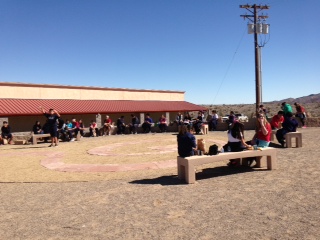
Outside picnic
The field trips have been pilot programs and we’re trying to hire someone with an education background who actually knows school curriculum and can adjust the programs to fit different grades.  But I think we’ve done pretty well on our own to start.  It’s made me remember when I was doing Care Cadets at the LA/SPCA every summer, teaching kids only a little older than these about volunteering at the shelter, working with animals, training dogs.  I always loved that and thought that was the kind of thing I would want to do as a career.  I could totally seen myself as the education co-ordinator for the LA/SPCA when I went off to school.  I loved working with the kids, even when they were being exasperating. I loved talking to people of all ages about how to take care of animals, spaying and neutering their pets, and all sorts of things.  It’s funny, because I always think of myself as not being very good with people and not liking kids.  But then I get in these situations and it’s great.  Maybe I don’t know myself as well as I think, or I’m now remembering parts of myself and what I used to enjoy.  Either way, as crazy as the field trips have made February, I’m really glad to have been a part of it.